Pianist
Josefina Urraca
Co-director of CreArtBox & Festival ADAR
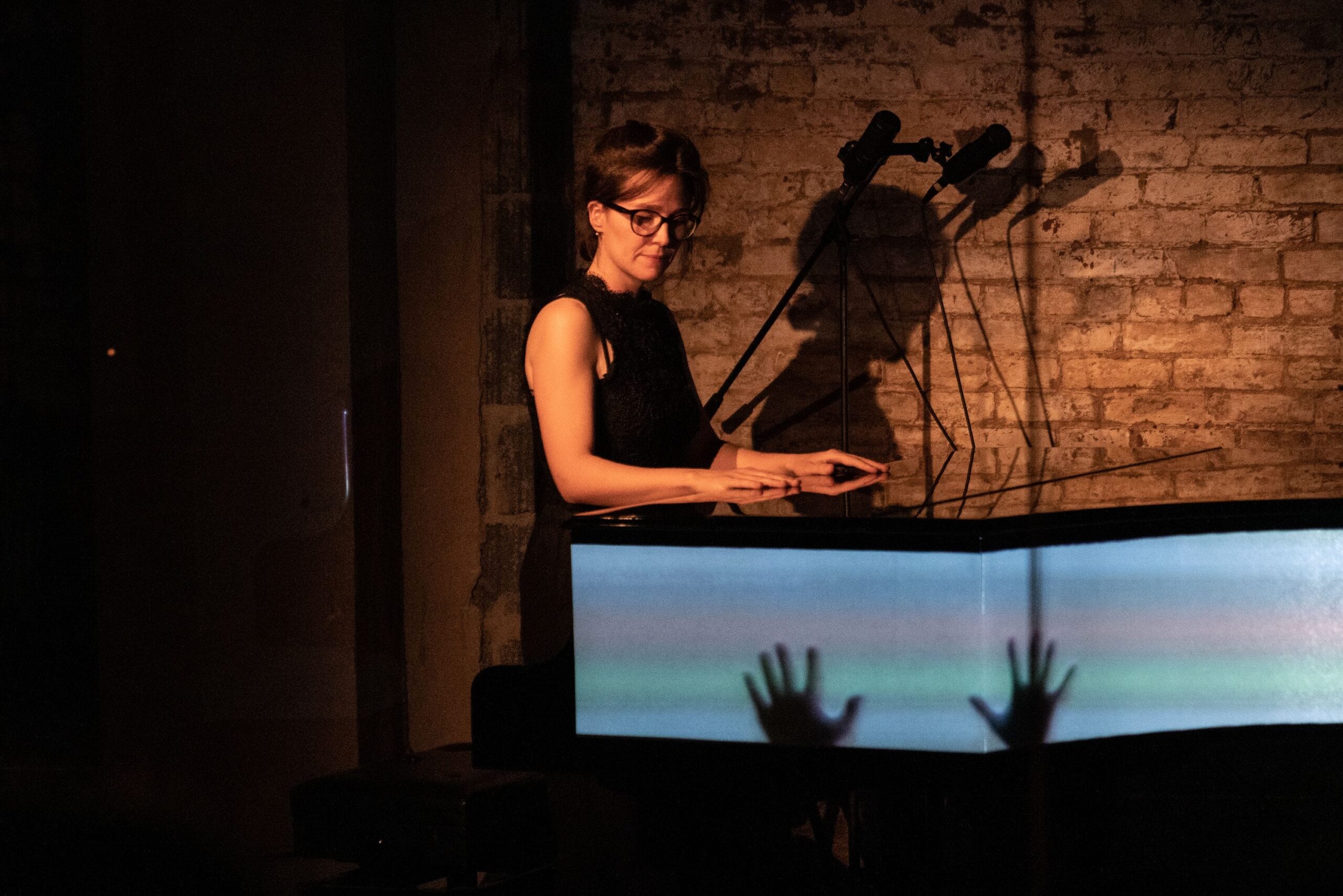
Josefina Urraca is a Spanish pianist and co-director of CreArtBox and the Festival ADAR. Her playing has been praised by Mundo Clásico for its blend of “introspection and musical abandon” — a balance between precision and emotional risk that defines her work both on stage and behind it.
She has performed at the Salle Cortot in Paris, the Collège d’Espagne at the Cité Internationale Universitaire de Paris, the Sony Auditorium in Madrid, Carnegie Hall in New York, among others. Her work has also reached wider audiences through appearances on Spanish television and radio.
Be meticulous, and free — honoring every detail of the score while letting the music breathe with emotion and spontaneity.
— Josefina Urraca
In 2013, alongside flutist Guillermo Laporta, she co-founded CreArtBox, a New York-based chamber music ensemble that fuses live performance with visual art, projection, and theatrical staging. Over the past decade, she has led its artistic direction — designing programs, commissioning new work, and building collaborations with composers and visual artists. The ensemble has been recognized by The New Yorker as one of its top picks for art and music, and by Time Out New York as “a group dedicated to multidisciplinary events.”
Since 2021, together with Laporta, she has co-directed Festival ADAR, a traveling arts festival in rural Asturias that weaves classical concerts, commissioned works, artist talks, and site-specific installations into the landscape of small villages. The festival has become a model for how contemporary art can revitalize rural heritage.
Over fifteen years, her work has received support from institutions including the New York State Council on the Arts, the NYC Department of Cultural Affairs, the Amphion Foundation, tehe Copland Foundation, and the Alice M. Ditson Fund, the Government of Asturias, the Queens Council on the Arts, the Spanish Embassy, Caja Madrid, the Luis Galvé Foundation, the Albéniz Foundation, and Caja Rural. She has been recognized in competitions including the Savvy Musicians in Action International Competition, INJUVE, Montehermoso Contemporary Creation, the Ciudad de Carlet International Competition, and the Rotary Club awards.
Her training took shape across the Salamanca Conservatory, the University of Alcalá de Henares in Madrid, the École Normale de Musique “Alfred Cortot” in Paris, the Reina Sofía School of Music in Madrid, and the Manhattan School of Music in New York. She has studied with Dmitri Bashkirov, Maria João Pires, Ferenc Rados, Patrín García-Barredo, Josep Colom, Claudio Martínez-Mehner, Kennedy Moretti, Eldar Nebolsin, Marc Silverman, Márta Gulyás and Frank Wibaut.
Born into a family of professional musicians in Palencia, she divides her life between New York and Leiguarda, a small village in Asturias, where she lives with her husband Guillermo and their son and daughter Eliot and Emilia.
Questions
FAQ
What is your process working in outside the box venues?
Each project begins with researching the venue and building a program that responds to its character. These settings allow us to break traditional boundaries, connect more closely with audiences, and create immersive, site-specific performances.
Why chamber music?
Chamber music is a deeply human form of expression where dialogue, listening, and shared intuition come together. It offers intimacy, trust, and artistic depth that continues to inspire me as both performer and collaborator.
What is your teaching philosophy?
I believe teaching is a collaborative and personal process. I work with a limited number of students to provide individual attention, blending technical rigor with creative exploration and encouraging each student to develop their own artistic identity.